
Counting the Cost – How Much Does Litigation Actually Set You Back?

Why Understanding Litigation Costs Is Critical for Your Case
How much does litigation cost? This question weighs heavily on anyone facing a legal dispute, especially when dealing with estate matters during an already difficult time. The short answer is that litigation costs can range dramatically – from around $7,500 for a case that settles quickly to well over $200,000 for complex disputes that go to trial.
Here’s what you need to know about litigation costs:
Typical Cost Ranges by Case Type:
- Automobile cases: $43,000 (median)
- Real property disputes: $66,000 (median)
- Contract disputes: $91,000 (median)
- Professional malpractice: $122,000 (median)
- Complex business litigation: $200,000+ (can exceed $1 million)
Main Cost Components:
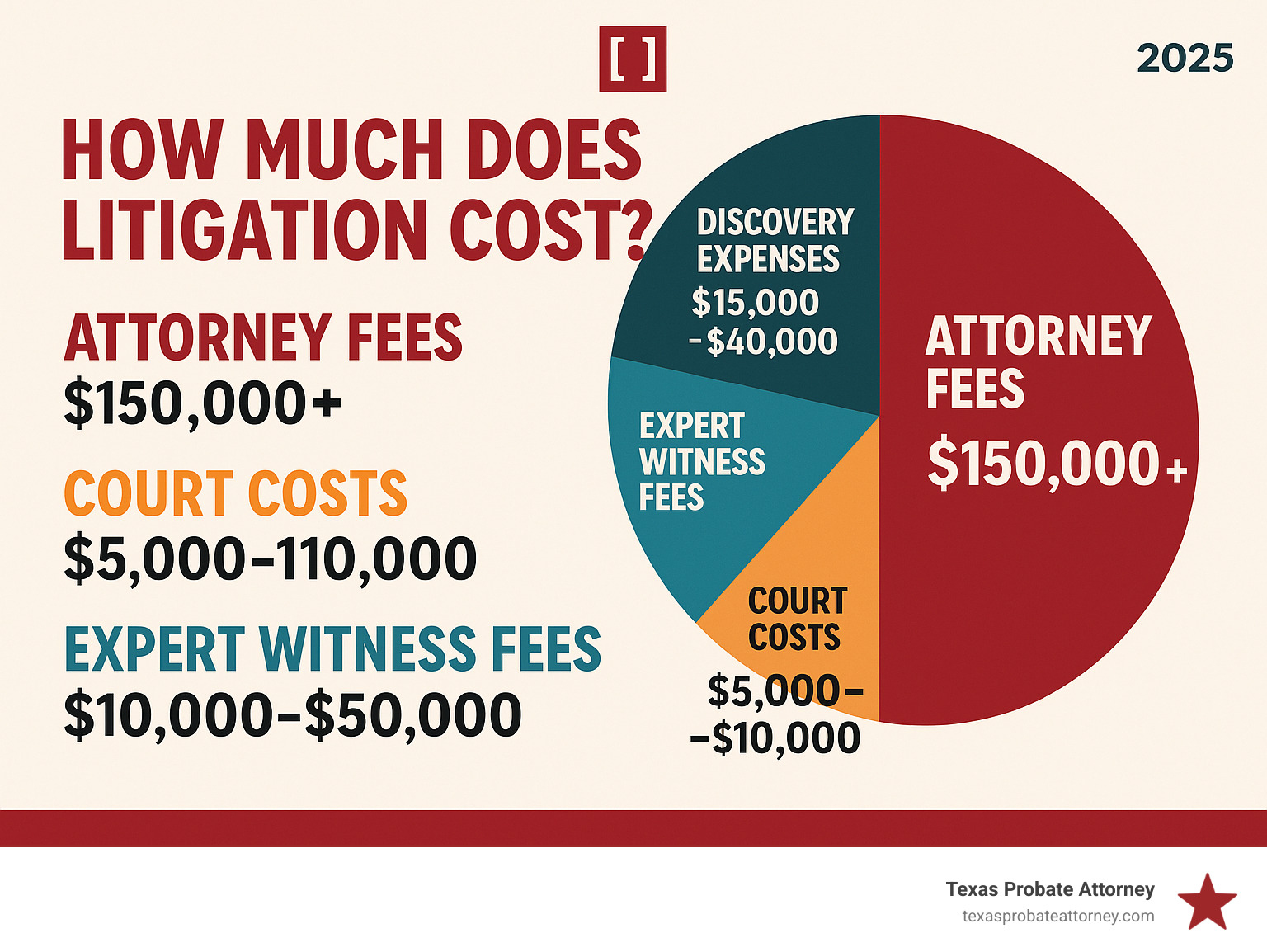
- Attorney fees: $150-$800+ per hour (or 33-40% contingency)
- Court filing fees: $337+ for cases over $50,000
- Expert witness fees: $100-$1,000+ per hour
- Findy costs: Can average $15,000 per case
- Deposition expenses: Around $10,100 average per case
Justice is expensive in the United States. As one legal expert noted, “Every citizen has the right to seek redress in court—but the problem is paying the bills.” The costs are not just unpredictable – they can quickly spiral beyond what most people expect.
Understanding these financial realities upfront helps you make informed decisions about whether to pursue litigation, settle early, or explore alternative dispute resolution. This guide breaks down exactly what drives litigation costs and what you can realistically expect to pay.
Breaking Down the Bill: What Are Litigation Costs?
How much does litigation cost? Federal law (26 U.S.C. § 7430) treats “reasonable litigation costs” as three broad buckets:
- Court costs and filing fees
- Expert witness and necessary report expenses
- Attorney fees (subject to statutory caps unless special circumstances apply)
Understanding these categories early lets you budget intelligently and decide whether to litigate, settle, or use alternative dispute resolution.
Attorney Fees: The Largest Slice of the Pie
Most litigants pay by the hourly model—anywhere from $150 to $800+ per hour, plus an upfront retainer ($5,000–$25,000+).
Contingency arrangements (one-third to 40 % of any recovery) shift risk to the lawyer, while flat fees appear only in the simplest matters.
Before signing, ask exactly how the firm tracks time and how often you’ll receive statements.
Beyond the Lawyer: Common Out-of-Pocket Expenses
Even modest lawsuits generate a steady drip of expenses:
- Court filing fees: about $337+ for cases over $50 k, plus a jury demand fee in many courts.
- Service of process: $60 by sheriff; $75–$150 per attempt with a private server.
- Expert witnesses: $100–$1,000+ per hour; day-long trial testimony can run several thousand dollars.
- Depositions: reporter attendance, transcripts ($3–$4 per page), and optional video recording.
- Document production & e-findy: scanning, hosting, and lawyer review often reach five figures.
- Administrative items: postage, courier, travel, exhibit prep.
Unchecked, these “little things” snowball. A clear cost-sharing plan with your attorney keeps surprises to a minimum.
More on litigation cost basics.
What Factors Drive Up the Price of a Lawsuit?

Litigation resembles home renovation: once you open a wall, you never know what you’ll find. Costs balloon when one or more of these variables appear:
- Case complexity – Multiple legal theories or tangled fact patterns demand more lawyer hours.
- Amount in controversy – Big dollars justify big budgets; small disputes need efficiency.
- Duration – Every extra month means more motions, conferences, and billing cycles.
- Number of parties – Each new player brings its own lawyers, depositions, and scheduling problems.
- Jurisdiction & court congestion – Some dockets move quickly, others crawl.
- Opponent’s strategy – An aggressive, well-funded adversary can intentionally run up costs.
The Findy “Black Hole”
Findy (collecting and exchanging evidence) is where spending often explodes. Written interrogatories, document requests, and depositions require attorneys to sift through mountains of data. In many modern cases, millions of electronic pages are produced even though only a fraction reach the courtroom.
Key ways to control findy:
- Negotiate reasonable search terms and date ranges early.
- Use technology-assisted review to cut lawyer hours.
- Seek court intervention promptly when the other side overreaches.
Settlement vs. Trial
Roughly 90 % of civil cases settle. That statistic reflects economics: courtroom time is expensive. Expect $2,000+ per trial day per side, not counting months of preparation. Appeals can double the tab.
Mediation or arbitration, though not free, typically resolves disputes faster and at a fraction of trial cost.
Learn about mediation & arbitration options.
How Much Does Litigation Cost? A Look at the Numbers

Below are median price tags compiled by the National Center for State Courts and other industry surveys. They are guidelines, not promises:
- Automobile injury – $43,000
- Premises liability – $54,000
- Real-property disputes – $66,000
- Employment matters – $88,000
- Contract disputes – $91,000
- Professional malpractice – $122,000
- Complex business litigation – $200,000+ (can exceed $1 million)
- Patent disputes – $1.5 million+ when $1–10 million is on the line
Costs tend to rise in U.S. courts compared with many foreign systems. Broader findy, jury trials, and higher hourly rates drive total tort spending here to roughly 2 % of GDP—roughly double that of Germany or the U.K.
For Fortune 500 companies, the average outside litigation bill hovers near $115 million per year.
For individuals and small businesses, the takeaway is simple: even “ordinary” lawsuits are financially serious. Early budgeting and candid cost-benefit analysis with counsel are essential steps.
Who Foots the Bill? Understanding Responsibility for Legal Costs

When facing litigation, one of the first questions clients ask us is: “If I win, will the other side pay my legal bills?” It’s a natural assumption – after all, if you’re in the right, shouldn’t the person who caused the problem pay for your attorney fees?
Unfortunately, the answer isn’t as straightforward as most people hope. How much does litigation cost you personally depends heavily on who’s ultimately responsible for paying the bills, and the rules governing this responsibility can be surprisingly complex.
Understanding these rules upfront is crucial for making informed decisions about your case. The difference between paying your own fees and recovering them from the other side can mean tens of thousands of dollars in your pocket.
The “American Rule” vs. The “English Rule”
Here’s where American law takes a different path than most of the world. Under what’s called the “American Rule,” each party typically pays their own attorney fees, regardless of who wins or loses the case. This means even if you achieve a complete victory, you’ll usually still be responsible for your own legal costs.
This is actually a departure from English common law, where the losing party traditionally pays the winner’s reasonable attorney fees. Under the “English Rule,” which many countries still follow, the stakes are higher for both sides. If you lose, you’re paying not just your own attorney but the other side’s as well.
The American system was designed to encourage access to the courts without fear of devastating financial consequences. The thinking was that people shouldn’t be afraid to seek justice just because they might have to pay the other side’s legal bills if they lose.
However, this also means that in America, litigation can be expensive for everyone involved, even the winners. As the Department of Justice notes in their Civil Resource Manual, “The general rule in this country is that each party to a lawsuit ordinarily shall bear her own attorney’s fees.”
Exceptions to the Rule: When the Other Side Pays
While the American Rule is the default, several important exceptions can shift who pays the legal bills. These exceptions often make the difference between a pyrrhic victory and a truly successful outcome.
Contractual provisions represent one of the most common exceptions. Many contracts include fee-shifting clauses that state the prevailing party in any dispute can recover attorney fees. These provisions are generally enforceable and can dramatically change your litigation strategy. We always examine contracts carefully for these clauses because they can turn a marginal case into a worthwhile fight.
Statutory fee-shifting applies in numerous federal and state laws. Congress and state legislatures have decided that certain types of cases are so important that winning parties should recover their fees. This includes civil rights cases, employment discrimination claims, consumer protection violations, and some environmental law cases.
Bad-faith litigation can also trigger fee-shifting. When someone files frivolous claims, engages in harassment through the legal system, or violates court orders, judges have the power to make them pay the other side’s attorney fees. We’ve seen this happen when parties use litigation as a weapon rather than seeking genuine resolution.
Court sanctions provide another avenue for fee recovery. Judges have inherent power to sanction parties who abuse the litigation process, and these sanctions often include paying the other side’s legal costs.
Settlement agreements frequently include fee-shifting provisions. Even when the law doesn’t require it, parties can negotiate who pays attorney fees as part of resolving their dispute. This often becomes a significant bargaining chip in settlement discussions.
In our practice, we always analyze potential fee-shifting opportunities early in each case. Understanding these rules can dramatically affect both litigation strategy and settlement negotiations. Sometimes a case that looks expensive becomes much more attractive when you realize the other side might end up paying your legal bills.
Texas Fiduciary Litigation Attorney.
Frequently Asked Questions About Litigation Costs
How much does litigation cost if a case settles quickly?
How much does litigation cost when everything goes smoothly? Even in the best-case scenario, you’re looking at a minimum of around $7,500 for a case that settles promptly after the defendant is served. This assumes your attorney can quickly assess the case, file the necessary paperwork, and negotiate a settlement without extensive back-and-forth.
This “express lane” cost includes the initial case assessment and strategy development, where your attorney reviews your situation and determines the best approach. You’ll also pay for drafting and filing the complaint – the formal document that starts your lawsuit. Service of process fees come next, which means officially notifying the other party they’re being sued.
Even quick settlements require some basic findy and document review to understand the key facts and gather supporting evidence. Finally, your attorney will handle settlement negotiations, which can take several rounds of offers and counteroffers.
The beauty of prompt settlement is that it avoids the most expensive parts of litigation. You won’t pay for extensive findy battles, expensive expert witnesses, or lengthy trial preparation. However, even “quick” settlements require significant attorney time for case evaluation, legal research, and skilled negotiation to get you the best possible outcome.
Can I get my attorney’s fees back if I win my case?
This is probably the most disappointing answer we have to give clients: generally, no. Under the American Rule, winning your case doesn’t automatically mean the other side pays your legal bills. You could win every single issue and still be responsible for your own attorney fees.
However, there are important exceptions that can completely change this picture. Contractual fee-shifting clauses in your original agreement with the other party can require the loser to pay the winner’s attorney fees. Many business contracts and leases include these provisions.
Statutory fee-shifting applies in certain types of cases where Congress or state legislatures have decided that prevailing parties should recover their fees. This includes civil rights cases, employment discrimination claims, and various consumer protection violations.
Bad-faith litigation can also trigger fee-shifting. If the other party files frivolous claims, engages in harassment tactics, or abuses the findy process, courts can order them to pay your attorney fees as punishment.
Courts can also impose sanctions for findy abuse or other litigation misconduct, which often includes paying the other side’s legal costs.
This is why it’s crucial to discuss fee recovery possibilities with your attorney from day one. Sometimes the potential for fee recovery can make the difference between a case that makes economic sense and one that doesn’t. We always analyze these opportunities early because they can dramatically affect litigation strategy and settlement negotiations.
Are probate and estate litigation costs paid from the estate?
In estate and probate cases, the answer is often yes – but it’s more complicated than in regular litigation. The key question is whether your legal work benefits the estate as a whole or just serves your individual interests.
Legitimate estate administration costs are typically paid from estate assets. If you’re the executor handling routine probate matters, those legal fees usually come from the estate before assets are distributed to heirs.
Disputes that benefit the estate may also have legal fees paid from estate funds. For example, if you’re fighting to recover assets that were improperly taken from the estate, or defending against frivolous claims, the estate often covers these costs because everyone benefits from the outcome.
However, personal disputes between heirs are different. If you’re fighting with your siblings over who gets what, or challenging the will because you feel shortchanged, you might have to pay your own legal fees. Courts view these as personal matters rather than estate business.
Unsuccessful challenges to valid wills can be particularly expensive. If you contest a will and lose, you might be personally liable for not only your own fees but potentially the other side’s fees as well.
The tricky part is that the ultimate source of payment may not be determined until the case concludes. Courts have discretion in estate matters, and they consider factors like whether the litigation was reasonable, whether it benefited the estate, and whether the parties acted in good faith.
This is one reason why estate litigation can be particularly complex from a cost perspective. Multiple parties may have different fee arrangements, and the final bill might be split in ways you don’t expect. We always discuss these possibilities upfront so our clients understand the potential financial outcomes.
Who Pays Probate Attorney Fees in Texas?.
Conclusion: Navigating the Financial Realities of a Lawsuit
When you’re facing a legal dispute, understanding how much litigation costs isn’t just helpful—it’s essential for making smart decisions about your case. The financial realities can be tough to swallow, but knowing what to expect puts you in control.
Litigation is expensive, unpredictable, and usually costs more than you first think. But here’s the thing: this knowledge actually empowers you. When you understand the true costs upfront, you can make informed choices about your legal strategy instead of getting surprised by mounting bills.
The most important things to remember: Litigation costs can range from $7,500 for a case that settles quickly to hundreds of thousands for complex trials that drag on. Attorney fees will likely be your biggest expense, but those “little” out-of-pocket costs add up fast. Findy often becomes the most expensive phase and can eat up resources with surprising speed.
Here’s some good news: 90% of cases settle before trial, largely because both sides realize how expensive and risky going to court can be. Under the American Rule, each party typically pays their own fees regardless of who wins, though important exceptions can shift this responsibility.
Smart strategies can save you money. Early settlement discussions can dramatically reduce costs. Alternative dispute resolution like mediation or arbitration offers cost-effective alternatives to full litigation. Understanding when fee-shifting might apply can completely change your case strategy. Most importantly, proper budgeting and cost management from day one prevents nasty surprises.
For disputes involving estates, trusts, or fiduciary duties in Texas, we at Texas Probate Attorney understand both the emotional and financial challenges you’re facing. With over 40 years of combined experience, Stacy Kelly and Stacy Kelly provide personalized guidance to help you understand potential costs and steer your case efficiently.
We believe in aggressive litigation when necessary, but we also know that the best outcome is often the one that resolves your dispute quickly and cost-effectively. Our goal is to give you realistic expectations about litigation costs upfront, so you can make informed decisions about how to proceed.
Litigation is a significant financial undertaking that requires careful consideration of costs, benefits, and alternatives. While the expense can be substantial, understanding these costs and working with experienced counsel helps you achieve the best possible outcome for your situation.
The complexity of litigation costs might seem overwhelming, but you don’t have to figure it out alone. When you know what drives costs up and what your options are, you can make choices that protect both your interests and your wallet.
To discuss your specific situation and get a clearer picture of the potential legal road ahead, contact a Texas Fiduciary Litigation Attorney.