
Choosing Wisely—Your Guide to Texas Independent Executor Appointments

Related Posts
Navigating Estate Settlement in Houston, Fort Worth, & Austin: The Independent Administrator
The appointment of texas executor independent administration in our service areas happens in two main ways:
- With a Will (Testate Estate): If the will, probated in Houston, Fort Worth, or Austin, explicitly names an independent executor and states they can serve without continuous court supervision.
- Without a Will (Intestate Estate) or If Will is Silent: All legal heirs must unanimously agree to independent administration and ask the probate court in Houston, Fort Worth, or Austin for approval.
When a loved one passes away in Houston, Fort Worth, or Austin, navigating the legal process of settling their estate can feel overwhelming. Dealing with the probate courts in Harris, Tarrant, or Travis County and their specific legal terms can be daunting for grieving families. But Texas law, as applied in these courts, offers a unique way to simplify this process: independent administration.
This approach, frequently used in Houston, Fort Worth, and Austin probate cases, allows a designated person, known as an independent administrator or executor, to manage the estate with minimal court oversight. It’s often faster, more cost-effective, and gives the family more control over the process.
This guide will help families in Houston, Fort Worth, and Austin understand the role of an independent administrator and how this streamlined method can bring peace of mind during a difficult time.
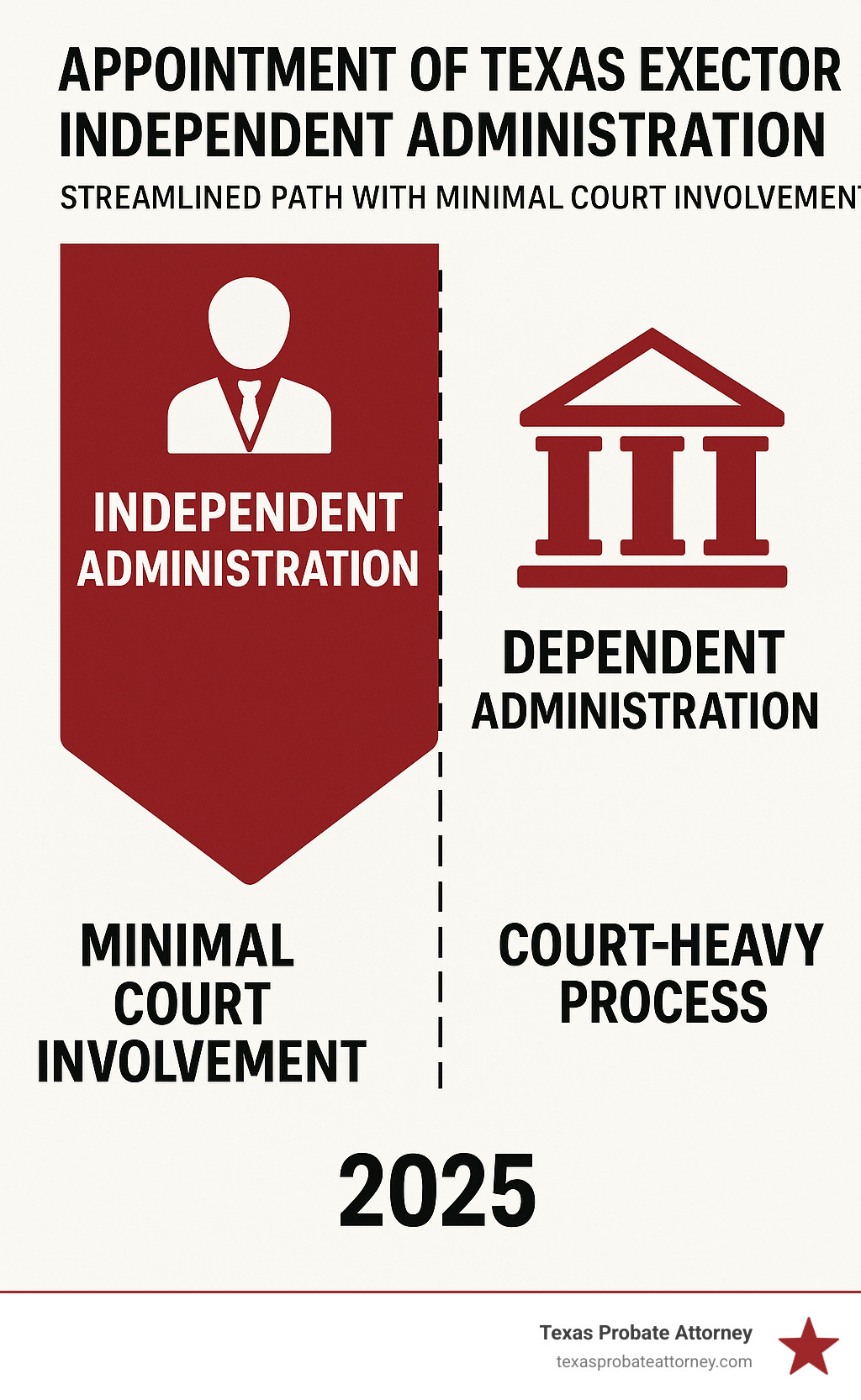
Appointment of texas executor independent administration terms at a glance:
- duties of independent administrator texas
- independent administration texas estates code
- what is an independent administrator in texas
Understanding the Role: Independent vs. Dependent Administration in Houston, Fort Worth, & Austin
When it comes to settling an estate in Houston, Fort Worth, or Austin, we primarily have two paths: independent administration and dependent administration. Think of it like this: independent administration is like being handed the keys to a car and told to drive to your destination, while dependent administration is like having a judge in the passenger seat dictating every turn and requiring approval for every stop.
Independent administration is often the preferred and most common method for probating estates in our service areas. From the busy courts of Houston to the historic halls of Fort Worth and the vibrant atmosphere of Austin, this streamlined process allows for the appointment of Texas executor independent administration, meaning the appointed person can manage the estate with minimal court supervision. This approach empowers the individual, who acts as a fiduciary—always working in the estate’s best interest—with greater freedom. This generally leads to lower costs due to reduced court fees and legal expenses, and it’s typically much faster, helping families settle estates with fewer delays in Houston, Fort Worth, and Austin.
This table breaks down the key differences you’ll encounter when probating an estate in the courts of Harris, Tarrant, or Travis County:
| Feature | Independent Administration | Dependent Administration |
|---|---|---|
| Court Oversight | Minimal; initial approval, then largely unsupervised | Extensive; court approval for most actions |
| Speed | Typically faster; fewer court hearings and approvals | Generally slower; continuous court involvement |
| Cost | Lower; reduced court fees and legal costs | Higher; more court appearances and attorney fees |
| Executor Control | High; broad powers to manage estate | Limited; requires court permission for key decisions |
| Bond Requirement | Often waived in will or by agreement | Usually required; an insurance policy for the estate |
| Privacy | Greater; fewer public filings (e.g., Affidavit in Lieu) | Less; more frequent public filings and accountings |
| Best For | Clear, uncontested estates with responsible administrators | Complex, contentious, or insolvent estates; minor heirs |
Defining the Independent Administrator
So, who exactly is an independent administrator in the context of a Houston, Fort Worth, or Austin probate case? In Texas, this term refers to the personal representative appointed by a local probate court to manage a deceased person’s estate with broad powers and minimal court supervision. If they were named in a will, you might also hear them called an “independent executor.”
Their main job is clear: estate management. This involves gathering all the deceased person’s assets, paying off any valid debts, and then distributing the remaining inheritance to the rightful beneficiaries according to the will or Texas law. The key here is their ability to act without court approval for most of these steps, a freedom that makes the process so much more efficient for estates in Houston, Fort Worth, and Austin.
As an independent administrator in one of these cities, you take on a fiduciary duty, which means you have a legal obligation to act solely in the best interest of the estate and its beneficiaries. This is a big responsibility! You’re entrusted with managing someone’s financial legacy in the local community, so diligence, honesty, and a keen eye for detail are truly essential.
How Independent Administration Streamlines the Probate Process
The real charm of independent administration, especially for families navigating probate in Houston, Fort Worth, and Austin, is its remarkable ability to streamline the probate process. Imagine fewer trips to the Harris, Tarrant, or Travis County courthouse and reduced legal fees because your attorney isn’t filing endless petitions. This approach offers wonderful flexibility in decisions, allowing the administrator to act promptly without waiting for a judge’s signature on every little thing. Plus, there’s increased privacy for the estate’s details, as fewer documents need to become public record.
All of this means faster asset distribution to heirs. Instead of waiting months or even years for court approvals, an independent administrator can move forward with collecting assets, paying debts, and distributing inheritances much more efficiently. This efficiency is precisely why independent administration is a favored choice for families in Houston, Fort Worth, and Austin, helping them close a chapter and move forward with their lives without unnecessary legal problems.
The Appointment Process in Houston, Fort Worth, & Austin
Okay, so you understand what an independent administrator does and why it’s such a great option for settling estates in Houston, Fort Worth, or Austin. Now, let’s talk about how you actually get that important job! The appointment of texas executor independent administration is a crucial first step. While the goal is minimal court supervision after appointment, getting appointed does involve the probate court in Harris, Tarrant, or Travis County. Think of it as getting your official “go-ahead” from a local judge.

The journey typically begins by filing an application for probate with the appropriate court in Houston, Fort Worth, or Austin. After that, there’s usually a short court hearing where a judge will review everything. Once the judge gives the green light, the newly appointed independent administrator takes an oath of office. It’s a formal promise to handle the estate properly. After that, the court issues “Letters Testamentary” (if there’s a will) or “Letters of Administration” (if there isn’t one). These “Letters” are like your official badge, confirming your legal authority to manage the estate, allowing you to access bank accounts, sell property, and handle other important tasks within these metropolitan areas.
Appointment with a Will in Houston, Fort Worth, & Austin
If your loved one was thoughtful enough to leave a valid will, and that will clearly names an independent executor, this is usually the most straightforward path. The will typically includes specific language that makes the process much smoother, saying something like: “I name [Name] as independent executor of my estate to serve without bond. I want the probate court to do nothing more than prove and record this will and accept any required list of my estate’s property and claims.”
That phrase “without bond” is a big deal! It means the executor doesn’t have to get an insurance policy to protect the estate, which saves money and avoids extra hassle. To get started, we file the will with the probate court in the proper county where the person lived – whether it’s the busy Harris County Probate Courts in Houston, the esteemed Tarrant County courts in Fort Worth, or the vibrant Travis County courts in Austin. If the will includes a “self-proving affidavit,” it makes the court hearing even simpler, because we don’t need witnesses to confirm the will’s validity. This entire process is guided by specific Texas laws, like Texas Estates Code Sec. 401.001, which lays out the provisions for independent administration when there’s a will.
Appointment Without a Will or by Agreement
What if there’s no will, or the will doesn’t specify independent administration? Don’t fret! The appointment of texas executor independent administration is still very much possible in Houston, Fort Worth, or Austin. However, it requires a key ingredient: unanimous consent from all legal heirs. This means every single person who stands to inherit from the estate must agree, in writing, to independent administration and to the specific person designated as the administrator. It’s a true team effort!
If there’s no will at all, an extra step called a “proceeding to declare heirship” is necessary. This is basically a legal investigation to officially determine exactly who all the legal heirs are. Sometimes, finding all family members can be like a detective mission, and if heirs are hard to locate, an “attorney ad litem” might be appointed by the court to help track them down. Once all heirs are identified and everyone agrees, we present this agreement to the court for approval. Generally, courts in Houston, Fort Worth, and Austin are happy to grant these requests, especially when it clearly benefits the estate. This process is detailed in laws like ESTATES CODE CHAPTER 401. CREATION. Just keep in mind: if even one heir objects, independent administration is off the table, and the estate will likely move into a more traditional (and often more costly and time-consuming) dependent administration.
Who is Qualified to Serve in Houston, Fort Worth, & Austin?
While many people can serve as an independent administrator, Texas law sets out specific qualifications to ensure the estate is managed responsibly and fairly. Generally, the person appointed should be a Texas resident. If an out-of-state resident is named, they often need to appoint a local Texas agent who can receive legal notices on their behalf. This helps ensure smooth communication with the probate courts in Houston, Fort Worth, or Austin.
The probate courts in Houston, Fort Worth, and Austin will not appoint individuals who are disqualified under Texas law. Specifically, Section 304.003 of the Estates Code lists certain individuals who are disqualified from serving:
- Minors: Someone under the age of 18 can’t serve.
- Incapacitated individuals: Those who are unable to manage their own affairs due to a physical or mental condition.
- Felons: Individuals convicted of a felony are usually disqualified, though there can be rare exceptions if the court finds them suitable.
- Certain corporations: Not all corporations are authorized to act as fiduciaries in Texas.
- Anyone the court finds “unsuitable”: This is a broad category, but it often applies to individuals with a conflict of interest, a history of dishonesty, or who are otherwise deemed incapable of fulfilling the demanding responsibilities of the role.
We always advise families in Houston, Fort Worth, and Austin to choose someone trustworthy, organized, and truly capable of handling financial and legal matters. After all, they’ll be driving the car!
Serving as an Administrator in Houston, Fort Worth, & Austin: Powers, Duties, and Realities
Alright, you’ve been appointed by a court in Houston, Fort Worth, or Austin! That’s a huge step, but it’s also where the real work—and trust—comes in. Judges in Harris, Tarrant, and Travis counties often talk about this role as one of “great trust and confidence.” And it truly is. As an independent administrator, you become a fiduciary. This fancy word simply means you have a legal duty to always put the estate’s best interests first. This includes keeping super organized record-keeping and, crucially, making sure the estate’s money stays separate in its very own estate bank account. Think of it as guarding a treasure chest! If things go awry, especially due to self-dealing or poor management, there’s a risk of personal liability, a serious concern for anyone managing an estate in these major Texas cities.

Primary Duties and Key Deadlines in Local Probate
So, what exactly do you do once you’re officially appointed by a court in Houston, Fort Worth, or Austin? There are clear steps and important deadlines to follow. First, you’ll take an Oath of Office within 20 days. This makes your appointment official. Then, you’ll get your Letters of Administration (or Letters Testamentary if there was a will) from the County Clerk’s office in Houston, Fort Worth, or Austin. These “Letters” are your official proof, like a special ID card, that shows banks and others you have the legal right to manage the estate.
Next up is dealing with creditors. You’ll need to publish a general Notice to Creditors in a local newspaper of general circulation in Harris, Tarrant, or Travis County within 30 days. This gives any unsecured creditors (like credit card companies) a chance to step forward with their claims. You also need to mail a direct notice to known secured creditors (think mortgage lenders) within 2 months.
Within 90 days, you’ll prepare an Inventory, Appraisement & List of Claims for filing with the court. This is basically a detailed list of everything the estate owns and owes. Or, if it makes sense for privacy, you might be able to file an Affidavit in Lieu of Inventory instead. This is a common practice in Houston, Fort Worth, and Austin to keep the estate’s specific details out of the public record, which many families prefer.
If there’s a will, you’ll need to send a Notice to Beneficiaries within 60 days of the will being accepted by the court. An affidavit proving you sent this notice then needs to be filed with the appropriate court in Houston, Fort Worth, or Austin within 90 days.
After these initial steps, your ongoing work involves collecting all the estate’s assets, like bank accounts or property. You’ll then pay off all valid debts and necessary taxes from the estate’s funds. Once everything is settled, your final big task is to distribute the remaining assets to the rightful heirs or beneficiaries, following the will or Texas law.
Finally, while not always a strict court requirement for independent administrations, it’s a good idea to officially close the estate by filing a Closing Report or Notice of Closing Estate with the court in Houston, Fort Worth, or Austin. This provides a clear end to your duties and helps ensure everything is wrapped up neatly.
The Benefits vs. Potential Pitfalls
Independent administration really shines when it comes to settling estates in Houston, Fort Worth, and Austin. It’s usually much faster, meaning fewer delays for families. Because there are fewer court visits to the local courthouse, it also typically means lower cost in legal fees and court expenses. Plus, you, as the administrator, have a lot more control and flexibility in making decisions.
But, just like anything, it’s not perfect for every single situation. When might independent administration not be the best choice for an estate in Houston, Fort Worth, or Austin?
- If the estate is insolvent (meaning more debts than assets), having the court in Houston, Fort Worth, or Austin oversee things can actually protect you from personal liability and ensure everyone gets a fair shake.
- If there are already family disputes brewing or if the will is likely to be contested, a judge’s direct involvement in the local probate court can help prevent small disagreements from becoming huge, expensive battles.
- For estates with extremely complex assets (like unusual businesses or investments), sometimes court guidance can be really helpful, even if an independent administrator can handle them.
The big risks to be aware of? You carry personal liability for mistakes, like paying a debt that wasn’t valid or mismanaging funds. And, honestly, dealing with beneficiary conflicts can sometimes feel like trying to herd cats – or worse, stepping into a hornet’s nest! It’s a lot of responsibility.
Compensation and Removal
Now, about getting paid for all this hard work! Independent administrators in Houston, Fort Worth, and Austin are definitely entitled to reasonable compensation for their services, which comes from the estate. Texas law often points to a statutory fee, typically around 5% of the gross value of the estate (though some assets might be excluded), as detailed in Section 352.003 of the Texas Estates Code. However, if the will says something different about payment, that’s what rules.
It’s important to know that an independent administrator appointed in Houston, Fort Worth, or Austin can be removed by the court. This isn’t common if you’re doing things right, but it can happen for reasons like failing to perform your duties (like not filing the inventory on time), mismanaging or embezzling estate funds, becoming incapacitated or otherwise unsuitable to serve. It also includes failing to make a final distribution of the estate within three years after getting your Letters, or engaging in self-dealing – meaning you act in your own interest instead of the estate’s. The grounds for removal, which are strictly enforced by judges in Harris, Tarrant, and Travis counties, are outlined in the Texas Estates Code, Section 404.0035. To avoid any trouble, we always tell administrators to stay on top of all deadlines and keep meticulous, clear records. After all, you’re driving the car, and you want to keep it on the road!
Navigating the Process with a Probate Attorney
Even with the ease of independent administration, you don’t have to walk this path alone. Having a trusted probate attorney by your side is truly a smart move. They can help you steer clear of costly missteps and make sure everything goes smoothly, whether you’re dealing with an estate in Houston, Fort Worth, or Austin.

Why an Attorney is Crucial for an Independent Administrator in Houston, Fort Worth, or Austin
Think of your probate attorney as your trusted co-pilot, guiding you through the legal landscape of settling an estate. They’re there to help you understand every detail of the will and make sure you follow all the rules of the Texas Estates Code. If there’s no will, they can handle those tricky heirship proceedings to figure out who the legal heirs are.
Your attorney also takes the lead on preparing all the necessary legal paperwork and making sure everything is filed correctly and on time with the court. This makes the appointment of texas executor independent administration much smoother. Should any disagreements pop up, or if someone decides to challenge the will, your attorney will be there to stand by you and defend the estate in the probate courts across Houston, Fort Worth, and Austin. Their main goal is to give you clear options, help you make the best choices for your family, and ensure the estate is handled properly and quickly.
Managing Complex Estate Issues in Houston, Fort Worth, or Austin
Sometimes, settling an estate can throw a few curveballs. Some estates have unique challenges that go beyond the usual tasks. We are here to help independent administrators in Houston, Fort Worth, and Austin with these more complex situations.
For example, if the person who passed away owned a business, we can help you steer its transition or sale. If there’s real estate involved, we’ll guide you through the process of selling it, making sure all the paperwork for title transfer is correct and follows the law. We can also help you understand any federal or state tax issues, like estate taxes or income taxes for the estate. And, if family members or beneficiaries start to disagree, we can step in to help resolve those disputes, always looking out for the estate’s best interest.
No matter how complicated the assets or family dynamics might seem, our aim is to ensure a smooth and legally sound closing for the estate.
Frequently Asked Questions about Texas Independent Executors
It’s natural to have questions when you’re looking into the appointment of texas executor independent administration. Many families in Houston, Fort Worth, and Austin wonder about the practical details of this streamlined process. Here are some of the most common questions we hear, answered simply and clearly.
How long does an independent administrator have to settle an estate in Houston, Fort Worth, or Austin?
One of the great things about independent administration is its flexibility. There’s no strict, rigid deadline for an independent administrator to settle an estate in Houston, Fort Worth, or Austin. However, the law does offer a guideline. The court may consider removing an administrator who hasn’t distributed the estate within three years after receiving their official Letters of Administration or Letters Testamentary.
This isn’t a hard-and-fast rule, but rather an encouragement for diligent administration. The key is to act reasonably and keep things moving forward. Staying organized and keeping beneficiaries informed about the progress can go a long way. This helps prevent misunderstandings or complaints that might otherwise lead to court involvement and delays for families in places like Houston, Fort Worth, and Austin.
Does an independent administrator in Houston, Fort Worth, or Austin have to be bonded?
This is a really common question! Most wills drafted for residents of Houston, Fort Worth, and Austin include a special provision that waives the bond requirement for the independent executor. This is a very popular choice because it saves the estate money by avoiding the cost of an insurance policy that acts as a safeguard.
If there isn’t a will, or if the will doesn’t mention the bond, the court can still waive it. This usually happens if all the legal heirs agree to it. However, it’s important to know that the court always has the final say. For estates that are very valuable or have complex assets, the probate courts in Houston, Fort Worth, or Austin might still require a bond. They do this to make sure the beneficiaries and creditors are protected, even if the will or heirs said it wasn’t needed. The court’s main goal is to protect the estate’s assets.
What happens if the heirs do not all agree to an independent administration in a Houston, Fort Worth, or Austin case?
This is a crucial point for the appointment of texas executor independent administration, especially when there isn’t a will, or if the will doesn’t specifically mention independent administration. In these cases, Texas law requires every single legal heir to agree. That’s right, for an estate being probated in Houston, Fort Worth, or Austin, unanimous consent is a must.
This means if even one heir objects to independent administration, or to who should serve as the administrator, then independent administration simply isn’t an option. When this happens, the estate will typically be forced into a “dependent administration.” As we’ve talked about, dependent administration means continuous court supervision for almost every step. This leads to more court filings, higher costs, and generally takes a lot longer to settle the estate. That’s why clear and open communication, and reaching an agreement among all heirs, is so incredibly important for families navigating the probate process in Houston, Fort Worth, and Austin.
Conclusion
Navigating the probate process in Houston, Fort Worth, or Austin can feel like a labyrinth, but the appointment of texas executor independent administration offers a clear path of efficiency and control. It’s truly the preferred and most common way to settle estates in these cities, designed to be faster and save you money because there’s less need for constant court supervision. We’ve talked about what an independent administrator does, and how they get appointed in Harris, Tarrant, and Travis counties—whether through a will or by agreement of all the heirs. This unique aspect of Texas law empowers individuals to manage local estates with greater freedom and less red tape.
Yes, the duties are significant, the deadlines set by the local courts are real, and the responsibilities are serious. But the benefits for families in Houston, Fort Worth, and Austin—like speed, lower costs, and more control—are substantial. However, just like any powerful tool, it does come with its own challenges and potential pitfalls. Think about things like personal responsibility and navigating tricky family dynamics. That’s why having seasoned guidance is not just helpful, it’s often essential for a smooth process in these busy metropolitan areas.
For personalized help with your unique probate situation, especially if you’re in Houston, Fort Worth, or Austin, we invite you to learn more about Independent Administration in Texas. Here at Texas Probate Attorney, our team, Stacy Kelly & Stacy L. Kelly, Attorneys at Law, brings over 40 years of combined experience in probate, t