
Texas Probate Explained—Attorney Ad Litem and Independent Administration

Understanding Attorney Ad Litem in Texas Probate Independent Administration
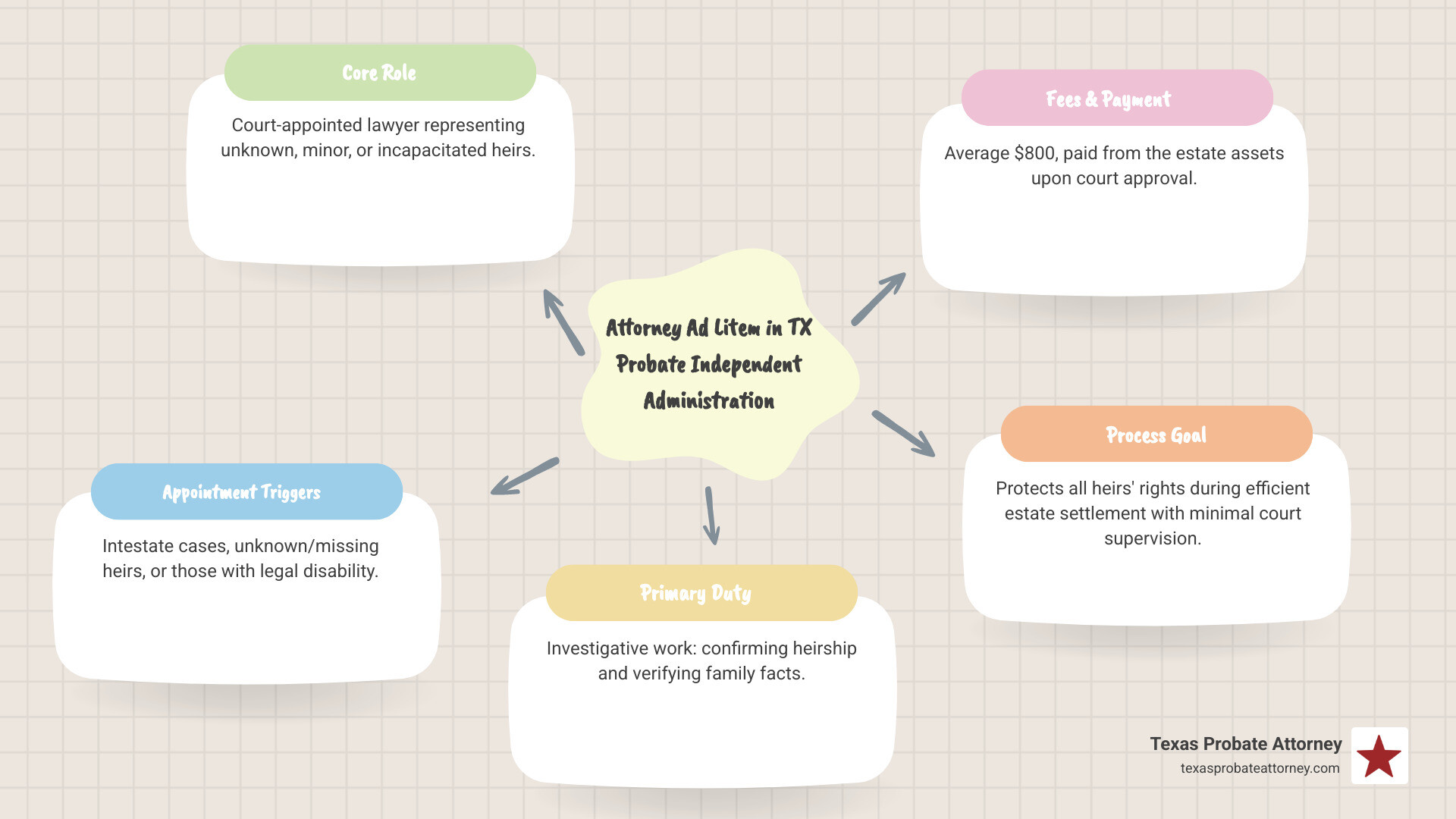
Attorney ad litem texas probate independent administration involves a court-appointed lawyer who represents unknown or incapacitated heirs when an estate goes through independent administration in Texas. This process is common in Houston, Fort Worth, and Austin probate courts when someone dies without a will or when heirs need special legal protection.
Key roles in this process:
- Independent Administrator – Manages the estate with minimal supervision from the probate courts in Houston, Fort Worth, or Austin.
- Attorney Ad Litem – A lawyer appointed by a local probate judge to represent unknown heirs, minors, or incapacitated individuals in a specific case.
- Probate Court – The specific court in Houston, Fort Worth, or Austin that oversees the process and ensures all heirs are properly represented.
When an attorney ad litem is appointed in Houston, Fort Worth, or Austin:
- The deceased left no will (intestate cases), requiring a judicial determination of heirship.
- Unknown heirs may exist who need representation before the court.
- An heir is a minor or lacks legal capacity, necessitating a court-appointed representative.
- The court requires citation by publication to notify missing heirs, triggering a mandatory ad litem appointment.
The attorney ad litem’s primary job is investigative—they work on behalf of the court to confirm no will exists and verify that all marriages, children, and potential heirs have been identified. Their fees, which are paid from the estate, are set by the judge and often average around $800, though this can vary by case complexity in courts across Houston, Fort Worth, and Austin.
In Texas probate courts across Houston, Fort Worth, and Austin, this combination allows families to settle estates efficiently while protecting the rights of all heirs, even those who cannot represent themselves.
As one probate manual notes: “In many cases, you will be merely verifying straightforward family facts. In other cases, the existence of living or predeceased heirs will not be disclosed, either because of ulterior motives or honest ignorance.”
Understanding Independent Administration in Texas Probate
When a loved one passes away in Houston, Fort Worth, or Austin, Texas law offers an efficient estate settlement process called independent administration. This preferred method allows the personal representative—an executor or an administrator—to manage the estate with minimal court supervision.

Once appointed by a court in Houston, Fort Worth, or Austin, the independent administrator can pay debts, sell property, and distribute assets without seeking the judge’s permission for each action. This autonomy provides several benefits:
- Cost-effectiveness: Fewer court appearances and less judicial oversight typically mean lower legal and administrative fees.
- Speed: Without the need for repeated court approvals, the estate settlement process can move much more quickly, allowing assets to reach beneficiaries sooner.
- Less Court Supervision: The independent administrator has more autonomy in decision-making, which can lead to a more flexible and less formal process.
The Texas Estates Code grants independent administrators the authority to manage estates efficiently, making it the preferred method for faster, more affordable probate for families in Houston, Fort Worth, and Austin.
Independent vs. Dependent Administration: A Clear Comparison in Houston, Fort Worth, and Austin
Understanding the alternative, dependent administration, highlights why independent administration is preferred in Houston, Fort Worth, and Austin. The primary difference is the level of court involvement and administrator autonomy.
| Feature | Independent Administration (Preferred in Houston, Fort Worth, & Austin) | Dependent Administration (More Court Oversight) |
|---|---|---|
| Court Oversight | Minimal after initial appointment in a Houston, Fort Worth, or Austin court | Continuous; court approval needed for most actions |
| Cost | Generally lower due to reduced court and attorney fees | Higher due to frequent court appearances and filings in local courts |
| Speed | Faster; fewer delays from busy court dockets in major cities | Slower; every action requires judicial review and order |
| Administrator Autonomy | High; administrator has broad powers to act | Low; administrator acts under strict court direction |
| Bond Requirements | Often waived by will or heir agreement, a common practice | Typically required by the court |
| Fiduciary Duty | Yes; administrator acts in the estate’s best interest | Yes; administrator acts in the estate’s best interest |
In a dependent administration, the administrator must get court permission for nearly every action, making the process slower and more expensive. This typically occurs when heirs disagree or the estate is complex. For these reasons, independent administration is the preferred route in Houston, Fort Worth, and Austin.
The Path to Appointment as an Independent Administrator in Houston, Fort Worth, and Austin
In the probate courts of Houston, Fort Worth, and Austin, an independent administrator can be appointed in two primary ways:
- Testate Estates (with a will): A valid will filed in a Houston, Fort Worth, or Austin court may name an independent executor and request the estate be administered independently, often without bond. This is the most direct path. A will might state: “I name [Name] as independent executor of my estate to serve without bond. I want the probate court to do nothing more than prove and record this will and accept any required list of my estate’s property and claims.”
- Intestate Estates (without a will) or by Agreement: When there is no will, or the will doesn’t specify it, all legal heirs must unanimously agree to independent administration and the choice of administrator. This agreement is filed with the court in Houston, Fort Worth, or Austin and must include consent from legal guardians for any minor or incapacitated heirs.
After the court appoints the administrator, they must file an Oath to qualify. They then receive “Letters of Independent Administration” or “Letters Testamentary,” which are official documents authorizing them to manage estate affairs. Our team assists families in Houston, Fort Worth, and Austin with these local court procedures.
The Crucial Role of the Attorney Ad Litem in Houston, Fort Worth, and Austin

Even in a smooth independent administration in Houston, Fort Worth, or Austin, a probate court will appoint a special representative: the attorney ad litem. This role is vital to ensure fairness and protect the interests of those who cannot represent themselves before the court. An attorney ad litem texas probate independent administration is a lawyer appointed by a Texas probate judge to represent the interests of unknown heirs, missing heirs, or individuals with a legal disability (minors or incapacitated adults). Probate courts in Houston, Fort Worth, and Austin commonly make this appointment in intestate cases (no will) or when an heir requires special legal protection. The appointment ensures the rights of vulnerable or missing heirs are protected. Understanding this role is key if you need a Probate Attorney in Texas.
When is an Attorney Ad Litem Appointed in Houston, Fort Worth, and Austin?
An attorney ad litem appointment is required by law in specific situations to ensure a fair probate process. In Houston, Fort Worth, and Austin, an appointment is typically made in the following circumstances:
- Intestate Cases: In local cases without a will, a “determination of heirship” proceeding is required to identify the legal heirs. An attorney ad litem is appointed to investigate the family history for the court.
- Unknown or Missing Heirs: If legal notices (citations by publication) go unanswered, the Houston, Fort Worth, or Austin court must appoint an ad litem to represent any individuals whose existence or location is unknown.
- Heirs with a Legal Disability: If an heir is a minor or is incapacitated, an attorney ad litem is appointed to represent their legal interests in the local probate matter.
Courts in Harris County (Houston), Tarrant County (Fort Worth), and Travis County (Austin) strictly follow these rules, recognizing the ad litem’s crucial role in a fair probate.
The Ad Litem’s Investigative Process in Local Probate Cases
Once appointed by a judge in Houston, Fort Worth, or Austin, the attorney ad litem acts as a neutral third party, conducting a thorough investigation of the deceased’s family history to verify the heirship information provided to the court. This process can involve detective work and genealogical research specific to the case.
The investigation includes:
- Verifying Family Facts: Reviewing documents like obituaries, marriage licenses, and birth certificates relevant to the family’s history.
- Interviewing Witnesses: Speaking with people knowledgeable about the family, including at least two disinterested parties who will not inherit and can testify in the local court.
- Conducting Searches: Using public records and other tools to locate potential heirs, acting as a genealogist or “skip tracer” to fulfill their duty to the court.
- Asking Difficult Questions: Inquiring about non-marital children, common-law marriages, or other relationships that could affect heirship to ensure no information is omitted from the court record.
The attorney ad litem then submits a detailed written report to the court. The report summarizes their findings, confirms or contests the applicant’s claims, lists evidence and interviewees, and includes a distribution chart. This chart clarifies each heir’s relationship to the deceased and their rightful share of the estate. Courts in Houston, Fort Worth, and Austin rely on these reports for their final decisions.
The Attorney Ad Litem and Independent Administration Process in Houston, Fort Worth, and Austin

In Houston, Fort Worth, and Austin, the attorney ad litem texas probate independent administration process combines the work of two key professionals: the independent administrator manages the estate, while the attorney ad litem identifies the rightful heirs for the court.
This partnership is critical in a heirship proceeding, a common step in local probate courts when someone dies without a will. The independent administrator relies on the ad litem’s court-mandated investigation to ensure assets are distributed to the correct people.
This system provides families in Houston, Fort Worth, and Austin with the efficiency of independent administration while protecting all heirs. It establishes a foundation for a fair judgment in both testate (with a will) and intestate (without a will) estates.
Our understanding of Texas Probate Law shows us that this dual approach protects everyone involved while keeping the process moving forward efficiently.
The Role and Responsibility of an Attorney Ad Litem in a Local Probate Case
An attorney ad litem appointed in Houston, Fort Worth, or Austin does not represent the family or the probate applicant. Their duty is to the unknown heirs, minors, or incapacitated individuals they are appointed to protect within that specific case.
The attorney ad litem must vigorously protect their clients’ rights before the court. If they find additional heirs or information that complicates the case, such as an unmentioned child, they are obligated to present it to the judge in Houston, Fort Worth, or Austin.
The attorney ad litem’s duties include filing an answer with the local court, conducting a thorough investigation, and attending the hearing to cross-examine witnesses. This ensures the court receives complete information to make a just ruling.
The ad litem’s investigation provides the independent administrator with a legally sound basis for ensuring accurate distribution of assets. This is especially important in cases involving blended families, which are common in Houston, Fort Worth, and Austin.
Our Estate Administration Lawyer Texas services often work alongside attorney ad litems, and we’ve seen how their thoroughness prevents future disputes and ensures the independent administration runs smoothly.
How an Attorney Ad Litem in Houston, Fort Worth, and Austin Handles Heirship
The heirship determination process in local courts begins when an interested party files an application for determination of heirship to settle the estate.
The Houston, Fort Worth, or Austin court then appoints an attorney ad litem and issues a citation by publication to notify any unknown heirs.
The attorney ad litem begins their investigation by reviewing documents and interviewing witnesses, including at least two disinterested parties who can testify about the family history without personal gain.
The ad litem files a comprehensive report with the court before the hearing, detailing their investigation, evidence, and conclusions about the rightful heirs and their respective shares.
At the heirship hearing in the local probate court, the ad litem questions witnesses to confirm their findings and ensure the judge has all facts regarding relationships that could affect inheritance.
Finally, the court issues a final judgment declaring heirship. This document serves as the official guide for the independent administrator to distribute the estate assets to the legally determined heirs in that specific case.
Practical Considerations: Fees, Conflicts, and Legal Guidance
In an attorney ad litem texas probate independent administration, it is important to understand practical matters like fees and potential conflicts of interest. This knowledge is key for anyone involved in settling an estate in Houston, Fort Worth, or Austin.
How are Attorney Ad Litem Fees Determined and Paid?
Families often ask about the cost of an attorney ad litem. Here is what you need to know:
The Texas probate court determines the ad litem’s fee, which is not negotiated. The court sets a reasonable compensation based on the time spent, case complexity, and the responsibilities undertaken.
Ad litem fees often average around $800, though in a city like Houston, a standard fee may be closer to $600, depending on the complexity of the investigation.
These fees are a cost of administration, paid from the estate’s assets, not by the heirs directly. However, some courts in the Houston, Fort Worth, or Austin areas may require the fee to be paid upfront. For more guidance, see our page on Houston Probate Attorneys Your Guide to Legal Services.
The court works hard to make sure the fee is fair for the vital work performed, balancing the ad litem’s efforts with the estate’s resources.
Potential Conflicts of Interest for an Attorney Ad Litem in Houston, Fort Worth, and Austin
An attorney ad litem appointed by a court in Houston, Fort Worth, or Austin must avoid all conflicts of interest to remain a neutral, unbiased representative for the court.
Their primary duty is solely to the interests of the unknown, missing, or incapacitated heirs they are appointed to represent in a specific case.
They do not represent the known heirs or the applicant, such as the independent administrator. Their role is separate and independent from the other parties involved in the probate matter.
The ad litem must maintain this independence to ensure their clients’ rights are protected and the heirship determination is accurate. This neutrality is vital to the integrity of every probate case heard in the courts of Houston, Fort Worth, and Austin.
Frequently Asked Questions about Texas Probate
The probate process can be complex. Here are answers to common questions from families in Houston, Fort Worth, and Austin:
How long does an independent administration take in Houston, Fort Worth, or Austin?
While streamlined, independent administration is not instant. The process takes a minimum of six months, and often longer in busy metropolitan areas like Houston, Fort Worth, and Austin.
Several factors contribute to this timeframe:
- Court Schedules: The initial hearing to appoint an administrator in Houston, Fort Worth, or Austin can take several weeks to a few months, as dockets in Harris, Tarrant, and Travis counties can be crowded.
- Creditor Notice Period: The administrator must publish a notice to creditors, which starts a mandatory four-month period for claims to be filed. Assets cannot be distributed during this time.
- Ad Litem Investigation Time: If an attorney ad litem is appointed, their investigation into unknown or incapacitated heirs can add a month or more to the timeline, depending on the complexity of the family history.
While faster than dependent administration, the process requires diligent action from the administrator to steer the specific timelines and procedures of the local court.
Can an independent administrator be removed in a Texas probate case?
Yes. An independent administrator is a fiduciary who must act in the best interest of the estate. If they fail to do so, an interested party can petition the court in Houston, Fort Worth, or Austin to have them removed.
Common reasons for removal in these courts include:
- Failure to Perform Duties: Failing to file the required inventory with the local court within 90 days or notify creditors within 30 days of appointment.
- Failure to Distribute Assets: Not distributing estate assets within a reasonable time, which local judges may consider to be around three years.
- Mismanagement of Funds: Misusing or embezzling estate funds, which can lead to removal and personal liability.
- Gross Misconduct or Incapacity: Demonstrating severe misconduct or becoming unable to perform their duties as judged by the court.
- Material Conflict of Interest: Developing a conflict that prevents them from acting impartially in the eyes of the court.
Our team at Texas Probate Attorney understands the local court procedures in Houston, Fort Worth, and Austin regarding administrator removal. If you’re an interested party concerned about an administrator’s actions, we can certainly help you understand your options.
What happens if heirs don’t agree on an independent administration in Houston, Fort Worth, or Austin?
If the deceased had no will or the will did not specify it, all legal heirs must unanimously agree to an independent administration for the court in Houston, Fort Worth, or Austin to approve it.
If even one heir objects or if they cannot agree on an administrator, the estate will likely proceed as a dependent administration in the local court.
This results in a more complex process for families in these areas:
- Increased Court Supervision: The administrator must get a judge’s approval for nearly every action, such as paying bills or selling property.
- Higher Costs: Frequent court filings and appearances in Houston, Fort Worth, or Austin lead to significantly higher legal and administrative fees.
- Slower Process: The need for constant court approval makes the entire process much slower and more complicated.
For these reasons, agreeing on independent administration is highly beneficial for families in Houston, Fort Worth, and Austin, as it saves time, money, and stress.
Navigating Your Probate Case in Houston, Fort Worth, and Austin
Understanding the roles of an independent administrator and an attorney ad litem is crucial for navigating the probate courts in Houston, Fort Worth, and Austin. It’s especially vital in cases involving an attorney ad litem texas probate independent administration – the unique setup used in local courts that lets estates be settled smoothly while making sure every heir, known or unknown, gets a fair shake.
We hope this guide has clarified these aspects of Texas probate law. Knowing how the process works can reduce stress for families in Houston, Fort Worth, and Austin during a difficult time.
Whether you’re facing a straightforward independent administration or a situation that calls for the keen investigative eye of an attorney ad litem, you don’t have to go it alone. At Texas Probate Attorney, our passion is providing personalized legal guidance for families just like yours, right here in Houston, Fort Worth, and Austin.
Our goal is simple: to help you understand your options clearly and empower you to make the very best decisions for your family and your loved one’s legacy. We’re here to help you every step of the way. We invite you to learn more about how we can assist with your probate and estate settlement needs in our vibrant Texas cities. You can find more helpful information on independent administration and the Texas Estates Code right here: Independent Administration Texas Estates Code.