Intestate Succession 101: Navigating the Estate Maze Without a Will

Understanding the Stakes: What Happens When There’s No Will
What is intestate succession? It’s the legal process that kicks in when someone dies without a valid will, leaving the state to decide how their property gets distributed. Instead of following the deceased person’s wishes, Texas law steps in with its own predetermined plan for who inherits what.
What Does Intestate Mean?
Intestate simply means a person died without leaving a legally valid will. When someone dies intestate, their property is distributed according to Texas intestate succession laws rather than the person’s own instructions.
In practical terms, this means the Texas Estates Code determines who inherits property such as homes, bank accounts, vehicles, and personal belongings. The probate court then supervises the process to ensure assets are distributed according to state law.
Many people assume their spouse or children will automatically inherit everything, but Texas intestacy laws can divide property in ways families may not expect. This is why estate planning and having a valid will are so important.
Quick Answer for “What is intestate succession”:
- Intestate = dying without a valid will
- Succession = the legal transfer of property after death
- Result = Texas state law determines who inherits your assets
- Process = Court-supervised distribution through probate
- Administrator = Court-appointed person manages the estate (instead of your chosen executor)
The numbers paint a sobering picture. According to a 2024 Caring.com survey, only 32% of Americans have a will. Even among those 55 and older, less than half (43%) have taken this crucial step. Perhaps more troubling, over one-third of Americans have witnessed or experienced family conflict due to inadequate estate planning.
When someone dies intestate in Texas, they essentially let the state legislature write their will for them. The probate court appoints an administrator to handle the estate, and Texas’s “laws of descent and distribution” determine which family members inherit – and in what order.
This process often creates exactly what grieving families don’t need: more stress, higher costs, and potential disputes over who gets what. The court follows a rigid hierarchy that might not reflect the deceased person’s actual wishes or family dynamics.
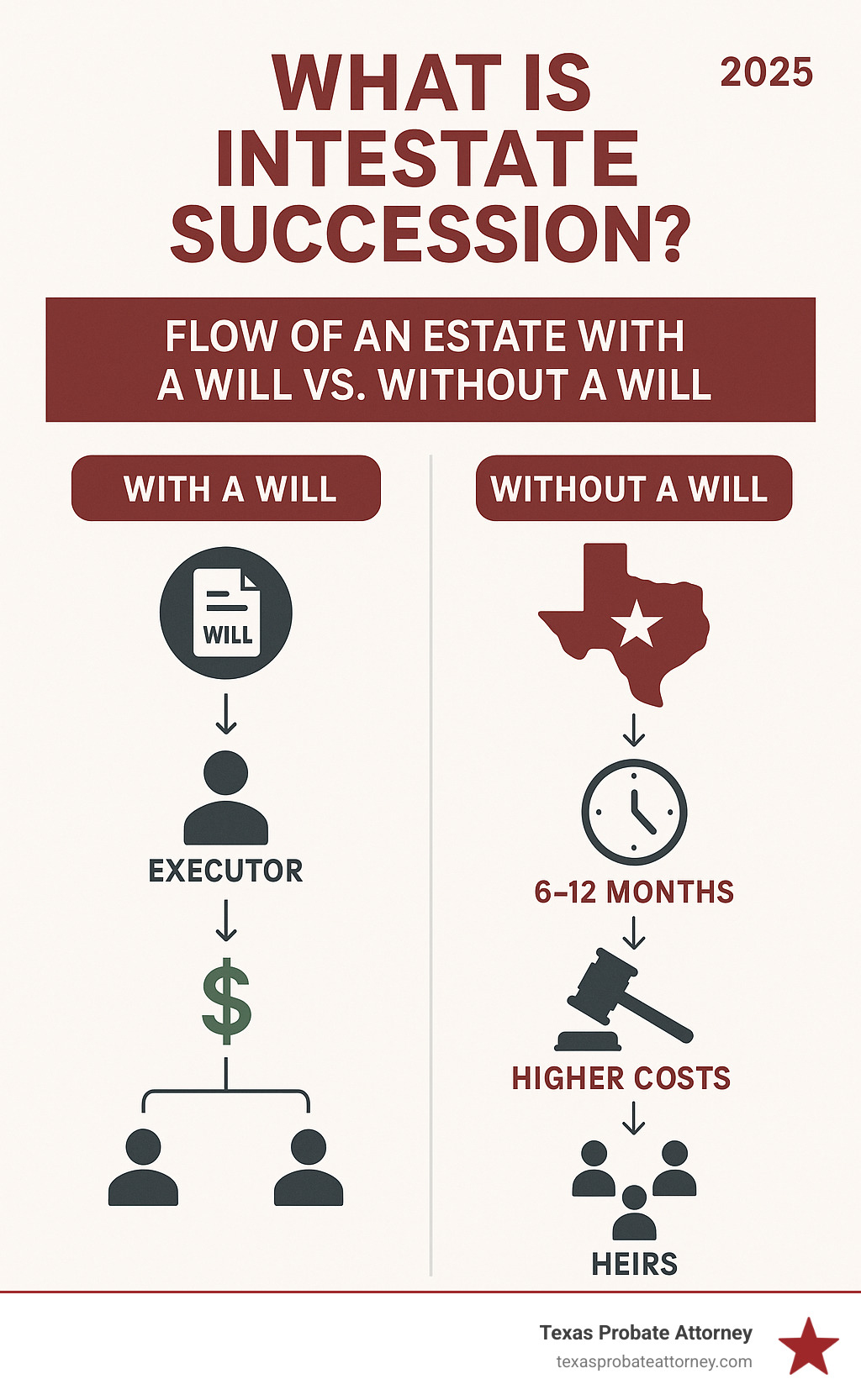
What is Intestate Succession? The Legal Default for Your Estate
When you die without a valid will, Texas decides who gets your property. This court-directed process is called intestate succession and it follows rules found in Texas Estates Code §§ 201.001–201.003.
What does “intestate” mean, and how does the process work?
- Intestate – dying without a legally valid will.
- Succession – the court-supervised transfer of property.
- Administrator – a person the judge appoints (instead of the executor you would have named).
The administrator must:
- Locate and list every probate asset.
- Pay valid debts, taxes, and expenses.
- Identify all legal heirs.
- Distribute what is left exactly as the statute requires – even if the family would prefer another arrangement.
Legal definition of “Intestacy” | What Happens If You Die Without an Estate Plan?
Why Do Intestate Succession Laws Exist?
They keep property from sitting in limbo, protect spouses and minor children, and provide a predictable way to clear title to real estate. Still, they are a blunt tool: lawmakers wrote them for “average” families, not for your unique situation.
The Probate Steps in an Intestate Estate
- File an application to open probate.
- Administrator appointed by the judge (spouse or adult child gets first priority).
- Inventory & notice to creditors and heirs.
- Debts/taxes paid from the estate.
- Heirship determined in a public proceeding.
- Assets distributed under the statute.
For a closer look at each step, visit our guide to Texas Probate Law.
Who Inherits? The Hierarchy of Heirs in Texas
Texas is a community-property state, so what each heir receives depends on whether an asset is community or separate property. Here is a streamlined snapshot of the statute:
| If You Leave… | Community Property | Separate Personal Property | Separate Real Estate |
|---|---|---|---|
| Spouse and children of that spouse | 100% to spouse | 1/3 spouse, 2/3 to children | Spouse gets 1/3 life estate; remainder to children |
| Spouse and children from another relationship | 50% to spouse, 50% split among all children | 1/3 spouse, 2/3 to children | Same as column at left |
| Spouse, no children | 100% to spouse | All to spouse (or 1/2 if a parent survives) | 1/2 to spouse, 1/2 to parents or siblings |
| Children, no spouse | ‑ | All to children equally | All to children equally |
| No spouse, children, parents, or siblings | ‑ | Passes up the family tree to grandparents, then aunts/uncles/cousins |
Texas Intestate Succession Chart
The following chart provides a simplified overview of how property is distributed when someone dies without a will in Texas. These rules come from the Texas Estates Code and are often referred to as the Texas laws of descent and distribution.
| Family Situation | Who Inherits |
|---|---|
| Married with children from that marriage | Spouse inherits community property; children inherit separate property shares |
| Married with children from another relationship | Spouse and children divide property according to Texas intestacy laws |
| Married with no children | Spouse inherits most or all property depending on whether parents or siblings survive |
| Unmarried with children | Children inherit the entire estate equally |
| No spouse or children | Parents, siblings, or extended relatives inherit according to Texas next-of-kin laws |
| No surviving relatives | Property may eventually pass to the State of Texas through escheat |
This chart simplifies a complex legal process. Actual inheritance outcomes can vary depending on the type of property involved and the specific family structure. If you are dealing with probate after someone dies without a will, consulting a probate attorney can help clarify how Texas intestate succession laws apply to your situation.
What Happens When Someone Dies Intestate in Texas?
When a person dies without a will in Texas, the probate court must determine who the legal heirs are under Texas intestate succession laws. This process is sometimes called an heirship determination.
The court will review family relationships, marital status, and whether the deceased had children. Texas law then follows a specific order of inheritance, starting with spouses and children, followed by parents, siblings, and more distant relatives if necessary.
This process can add additional time and legal expenses to probate because the court must formally establish the family tree before distributing assets.
No Heirs? Escheat to the State
If exhaustive searches turn up no living relatives, the property escheats to Texas. Heirs who surface later may still claim it, but only after proving their relationship. Learn more in this definition of escheat.
Who Never Inherits Under Intestacy?
- Unmarried partners (unless they can prove a valid common-law marriage).
- Stepchildren and foster children who were not legally adopted.
- Close friends, caregivers, and charities.
For details about leaving—or withholding—gifts, see Can I Disinherit My Child in Texas?.
Identifying the Intestate Estate: What’s In and What’s Out
When someone dies without a will, it’s tempting to think that all their property automatically goes through intestate succession. But that’s not actually how it works. Understanding which assets are subject to intestate succession – and which ones completely bypass the process – can be the difference between a family receiving what they expected and being left empty-handed.
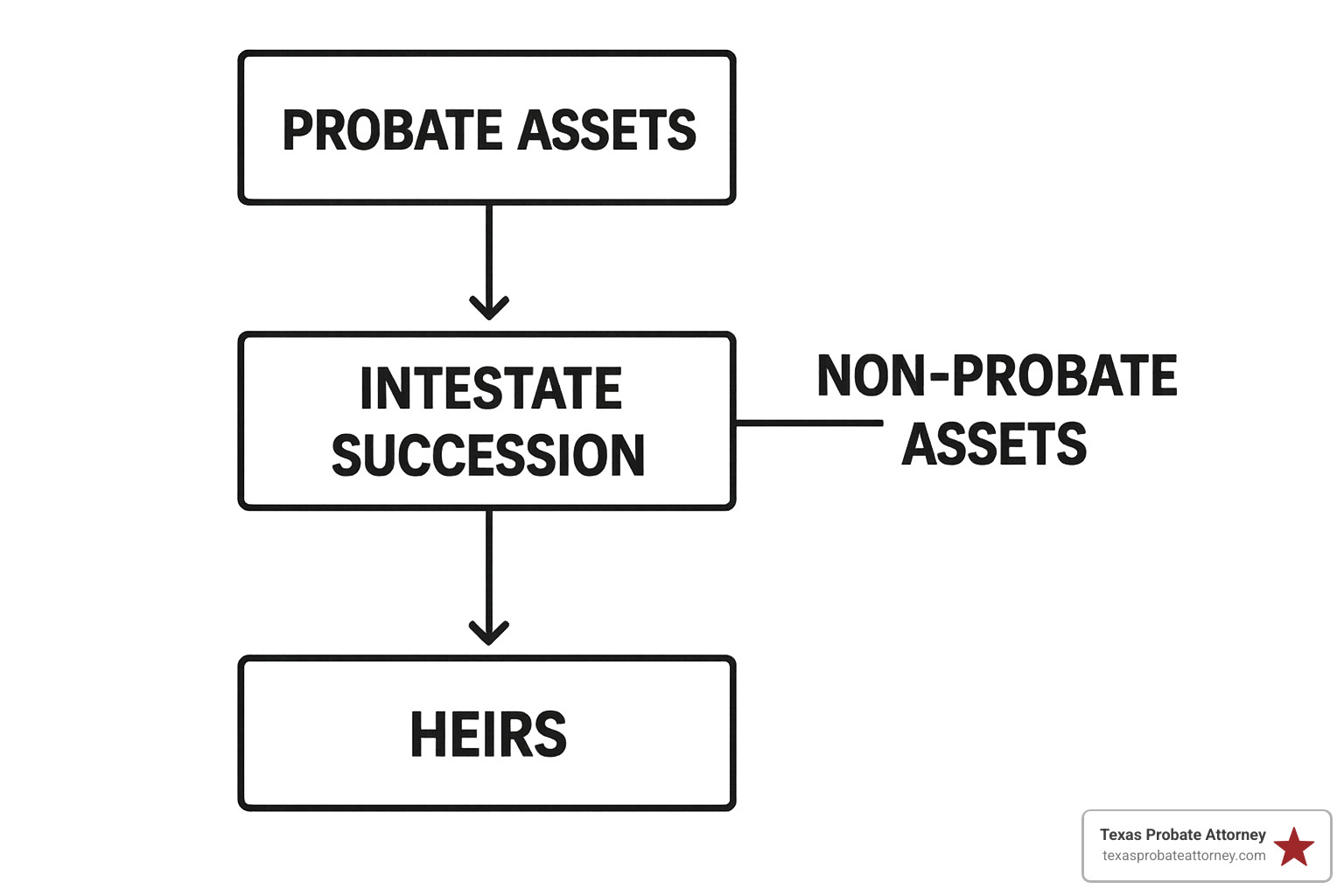
The key to understanding what is intestate succession lies in knowing the difference between probate assets and non-probate assets. Think of probate assets as property that “dies” with the person – it has nowhere to go automatically. Non-probate assets, on the other hand, have their own built-in instructions for where they should go next.
Probate assets must go through the court system and follow Texas intestate succession laws. Non-probate assets skip right past the probate court and go directly to whoever was designated to receive them. This distinction can dramatically affect what actually ends up being distributed according to the state’s intestate succession rules.
Probate in Texas Without a Will
Even when someone dies without a will, probate is still usually required. The probate court appoints an administrator to handle the estate instead of an executor named in a will.
The administrator is responsible for identifying assets, paying debts and taxes, determining legal heirs, and distributing property according to Texas intestate succession laws.
Although the process is similar to regular probate, intestate cases often take longer because the court must determine who the heirs are before property can be distributed.
Assets That Typically Go Through Intestate Succession
Probate assets are those lonely pieces of property that were owned solely by the deceased person without any automatic transfer mechanism. These assets form what lawyers call the “probate estate,” and they’re the only ones that actually go through intestate succession.
Real estate titled in the decedent’s name only is probably the most common probate asset. This includes the family home, rental properties, vacant land, or that little cabin in the woods that’s been in the family for years. If the deed shows only the deceased person’s name, it’s going through probate.
Bank accounts without beneficiary designations also end up in probate. That checking account where they deposited their paychecks, the savings account they never got around to updating, or certificates of deposit without payable-on-death beneficiaries – they all become part of the intestate estate.
Personal property represents another major category. We’re talking about vehicles, jewelry, furniture, artwork, collections, and all those tangible things that made up someone’s daily life. That vintage car in the garage, grandma’s wedding ring, or the antique furniture collection – if it doesn’t have a title or deed showing joint ownership, it’s going through probate.
Brokerage accounts without transfer-on-death beneficiaries also get caught up in intestate succession. Investment accounts that were meant to provide for the family can end up distributed in ways the deceased person never intended.
Business interests can be particularly problematic in intestate succession. Sole proprietorships, partnership interests, or corporate stock owned by the deceased person must go through probate, potentially disrupting business operations while the court sorts everything out.
Assets That Bypass Intestate Succession
Here’s where things get interesting – and where many people are surprised to learn that a significant portion of their assets might never go through intestate succession at all.
Life insurance policies are the classic example of non-probate assets. The proceeds go directly to named beneficiaries faster than you can say “probate court.” Unless someone made the mistake of naming their estate as the beneficiary, life insurance completely bypasses intestate succession.
Retirement accounts like 401(k)s, IRAs, and pension plans work the same way. These accounts pass directly to named beneficiaries according to the account documents, not according to Texas intestate succession laws. This can sometimes create surprising results – like when an ex-spouse receives retirement benefits because no one updated the beneficiary designation after a divorce.
Assets in a living trust follow their own set of rules. Property that was properly transferred to a revocable living trust passes according to the trust’s terms, completely sidestepping both probate and intestate succession. It’s like the trust creates its own private will for those assets.
Property owned in joint tenancy with right of survivorship automatically passes to the surviving owner. This includes real estate, bank accounts, and other property where the deed or title specifically includes survivorship language.
Payable-on-Death (POD) accounts and Transfer-on-Death (TOD) accounts are specifically designed to bypass probate. These simple designations on bank accounts and investment accounts can save families months of probate proceedings.
The tricky part is that many people have a mix of probate and non-probate assets without realizing it. They might have properly designated beneficiaries on their retirement accounts and life insurance but forgotten about their bank accounts and real estate. This means part of their estate bypasses intestate succession while the rest gets distributed according to state law.
For a more detailed explanation of how these different types of assets are handled in Texas, check out our comprehensive guide on Probate vs. Non-Probate Assets in Texas: What You Need to Know.
The Downsides and How to Avoid Intestacy

Why Dying Intestate Hurts Your Family
- Your voice is lost. State rules, not your wishes, decide who inherits.
- Higher costs & delays. Extra court hearings to determine heirs increase attorney fees and stretch the timeline—often 12–24 months.
- More family conflict. Blended families and estranged relatives often end up in court.
- No guardian named for minors. A judge chooses who raises your children.
- No tax or charitable planning. Opportunities to save money or support causes disappear.
Simple Ways to Stay in Control
- Sign a valid will. It names an executor, beneficiaries, and guardians.
- Keep beneficiaries updated on life insurance, IRAs, and POD/TOD accounts.
- Consider a living trust if you want to avoid probate altogether.
- Title property correctly, e.g., use joint tenancy with right of survivorship only when it makes sense.
- Review every few years or after major life changes.
Helpful resources:
The Importance of Having a Will | How to Avoid Probate Court in Texas
Frequently Asked Questions about Intestate Succession in Texas
What if a will is declared invalid?
The estate is treated as if no will ever existed. The court follows the intestacy statute, even when the document reflected the deceased person’s wishes.
Can a common-law spouse inherit?
Yes—but only after proving to the court that a common-law marriage existed (cohabitation, agreement to be married, and public representation as spouses). Disputes over this point can add months and significant legal expense.
How long does intestate probate take?
Expect 6–12 months for a simple estate and 1–3 years for complex or contested estates. Extra time is spent locating heirs, proving relationships, and resolving disagreements—time that could be saved with a well-drafted will.
What Are Texas Intestacy Laws?
Texas intestacy laws are the legal rules that determine who inherits property when someone dies without a will. These laws are found in the Texas Estates Code and establish a hierarchy of heirs based on family relationships. Understanding intestate succession is also important when considering the cost of probate in Texas, since cases without a will often require additional court proceedings.
Typically, a surviving spouse and children inherit first. If there are no immediate family members, property may pass to parents, siblings, or more distant relatives. If no heirs can be found, the estate may eventually pass to the State of Texas.
Conclusion: Take Control of Your Legacy

What is intestate succession? After exploring this comprehensive guide, you now understand it’s essentially the state of Texas making decisions about your life’s work and assets – decisions that should be yours alone. When you die without a will, you’re essentially handing over control of your legacy to lawmakers who never knew you, your family, or your values.
The reality is sobering. Without proper planning, your assets might go to estranged relatives while your closest friends receive nothing. Your minor children could end up with guardians you never would have chosen. Your family might spend months or years in court, watching legal fees eat away at what should have been their inheritance.
The risks of dying intestate are simply too significant to ignore. You lose complete control over who inherits your assets, potentially creating family conflicts that can last for generations. The probate process becomes longer, more expensive, and more stressful for everyone involved. Unmarried partners, stepchildren, and charitable causes you cared about are automatically excluded from receiving anything.
But here’s the good news: avoiding these problems is entirely within your power. Proactive estate planning ensures your wishes are honored and your family is protected during one of the most difficult times in their lives. A properly drafted will gives you control over your legacy while minimizing the burden on those you leave behind.
At Texas Probate Attorney, we’ve seen how proper planning can transform a potentially devastating situation into a manageable process. Stacy Kelly and Stacy L. Kelly, J.D., Partner, bring over 40 years of combined experience to help Texas families steer these complex waters. We understand that every family situation is unique, which is why we provide personalized legal guidance custom to your specific needs and circumstances.
Whether you’re just starting to think about estate planning or you’re dealing with the aftermath of an intestate succession, we’re here to help. Our approach combines aggressive representation with the quick resolutions that protect your interests and those of your family.
Don’t let the state write your will for you. Take control of your legacy today by ensuring your wishes are clearly documented and legally protected. Your family will thank you for taking this important step.
If you are facing a dispute over an intestate estate or need guidance through the probate process, contact our Houston probate litigation attorneys today. We also serve clients in Fort Worth and Austin, providing the same dedicated service and legal excellence throughout Texas.
Remember: the best time to plan your estate is now, while you can still make the decisions that matter most to you and your family.